

I’m way behind in getting you this run down on Episode 9 - so far behind, in fact, that you get a two-fer today. Episode 10 came out on 3/9/26 - it was recorded and published Monday because I was out of town so there was no live Substack feed. You will have to watch on YouTube.
At first glance, this may look like a routine legislative update—but by the end of this post you may see why some people at the Capitol would prefer these bills never reach a vote.
Despite Legislative Leadership Edict, PIKE OFF OTA advances FIVE BILLS
A few weeks back, the legislative leadership told its committee chairs to not hear any more eminent domain bills. Our bill authors relayed this edict to us and sent us a link to a Petroleum Alliance article as an explanation.
Except both our bill authors and we were confused because the article had nothing to do with eminent domain - it had to do with the Petroleum Industry being upset with the Legislature over the raising of production taxes back in 2015-2018, which they blame for the recent loss of Expand Energy and Devon Energy HQs.

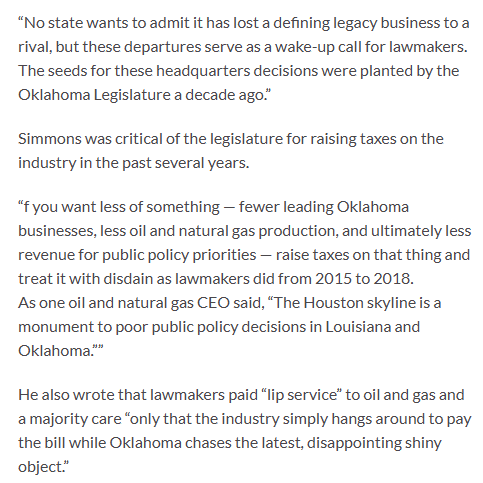
You should read the full letter from Brooks Simmons to the legislature. The Petroleum industry takes umbrage with the Legislature for increasing the production tax to one of the highest in the nation; essentially doubling their taxes in 2018, and blames this tax increase for the exodus of almost a dozen oil and gas companies to other states.
The Legislature at the time justified this tax increase by promising huge educational improvements - and yet Oklahoma still ranks near the bottom of the nation in educational metrics. So the Petroleum industry now wants to know where that money went and what it actually accomplished.
Brooks ended his letter by asking the lawmakers to reverse those policies to invite the oil and gas economic drivers back to our state.
Lawmakers have the authority and responsibility to reverse
policies that have made our state less attractive to capital, talent, and long-term investment, and to replace them with reforms that restore certainty, fairness, and competitiveness. - Brooks Simmons, President, Petroleum Alliance of Oklahoma
Tell me again how this letter justifies not hearing any bills on eminent domain reform?
When citizens started asking why their property-rights bills suddenly stopped moving through the Legislature, the official explanation didn’t make much sense. The petroleum industry’s letter focused on production taxes and economic policy — not eminent domain. So the obvious question became: if the letter wasn’t really about property rights, what actually caused leadership to quietly shut down debate on eminent domain reform?
Apparently, the current legislative leadership doesn’t want to draw any more ire from the industry by instating transparency and accountability in the eminent domain laws.
But obviously, the legislative leadership doesn’t truly understand the use (or lack thereof) of eminent domain in the oil and gas industry.
Oil and gas companies have mineral rights. They can horizontally drill. They do not use eminent domain.
Name one oil and gas company in the last twenty years to use eminent domain in the state of Oklahoma.
Midstream and pipeline companies might - although, they typically utilize easements and access agreements with landowners.
But oil and gas companies DON’T.
In fact, it seems like oil and gas companies would generally be in favor of making our eminent domain laws more protective of landowners because large infrastructure projects, like a highway, could result in the loss of a well or reserves (at least two wells that I know of will be paved over on the east side of the South Canadian River).
So what is going on?
The Capitol is Run By Lobbyists - Not Elected Officials
Who is the lobbyist for the Oklahoma Energy Producers Alliance, representing the independent oil and natural gas sector in Oklahoma, focusing on preserving wells and protecting the industry’s interests?
Who is also the lobbyist for the Oklahoma Association of General Contractors?
Who used to represent the Municipal Power Authority Board?
Who owns Capitol Gains, LLC., a major Oklahoma lobbying firm that represents numerous industry clients before the Legislature?

Who used to lobby for Epic Charter Schools?
The answer to these questions is the same person.
“You are who you hang out with”
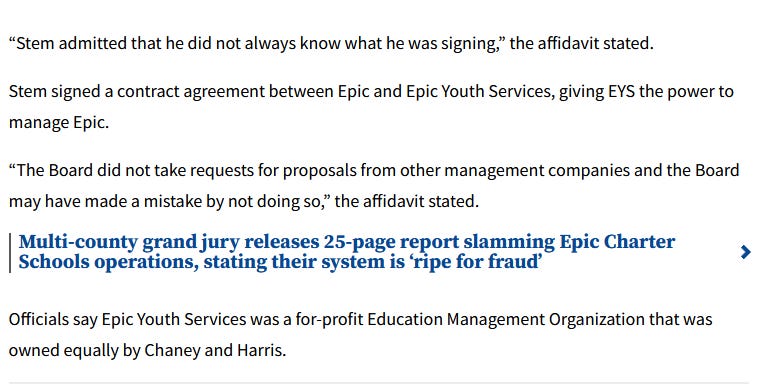
Bobby Stem, best known to the NO MORE TURNPIKES movement as the lobbyist for the Association of Oklahoma General Contractors (AOGC), previously served on the governing board of Epic Charter Schools and later worked as a lobbyist representing Epic interests at the Oklahoma Capitol.



Screenshot from the Oklahoma Ethics Commission 2014 list of Registered Lobbyists.
Epic’s founders, Ben Harris and David Chaney, were later charged by state prosecutors in a racketeering and embezzlement case involving the diversion of millions in public education funds. Their former chief financial officer (CFO), Josh Brock, plead guilty and testified against Harris and Chaney as part of a plea agreement, admitting to creating false invoices. As part of a plea deal to testify against co-founders Harris and Chaney, Brock agreed to 15 years of probation for his role, which included using the “Learning Fund” for personal expenses and issuing himself $1.1 million in illegal overpayments.

These articles detail that the co-founders of Epic established a private company, Epic Youth Services (EYS), that collected millions of dollars in management fees between 2013 and 2020 when the audit came out.

During that timeframe, Mr. Stem was the lobbyist for EYS.
Wow.
At last week’s press conference where lobbyist Bobby Stem called PIKE OFF OTA “domestic terrorists,” he warned legislators that “you are who you hang out with.”



That’s interesting advice coming from Mr. Stem, who previously served on the board of Epic Charter Schools and later became their lobbyist—advocating for the organization before its founders were ultimately charged with racketeering, embezzlement of state funds, conspiracy to commit a felony, and multiple other criminal counts.
So perhaps Mr. Stem’s advice is worth considering.
Because if legislators are judged by who they associate with, the public may reasonably ask the same question about the lobbyists attempting to influence them—particularly when those lobbyists are telling lawmakers that ordinary Oklahoma citizens opposing a turnpike should be treated as “terrorists.”
I’m not done with this topic. Stay tuned.
And if you are so inclined in the meantime, you may wish to review Oklahoma Ethics Commission lobbying rules 5.27, 5.28, and 5.29 (pp. 336–338) and consider whether the conduct described here raises questions worth bringing to the Commission’s attention.
But while the public was being told that homeowners are “terrorists,” something far more interesting was happening quietly behind the scenes at the Capitol.
$45 Breakfast to Guarantee no Eminent Domain Reform Bills be Heard
When lobbyists start calling ordinary citizens “terrorists,” it’s usually worth asking what policy fight they’re trying to distract from.
Remember the Petroleum Alliance article I mentioned earlier? The one complaining about production taxes and blaming the Legislature for driving oil and gas companies out of Oklahoma?
Legislative leadership pointed to that article as the reason committee chairs were told to stop hearing eminent domain reform bills this session.
Except the article had nothing to do with eminent domain.
Oil and gas companies don’t use eminent domain to drill wells, and the letter never even mentioned property-rights legislation.
So the explanation never really made sense.
And maybe it wasn’t supposed to.
Because sometimes the real story isn’t found in a policy letter—it’s found in places as mundane as a Capitol breakfast meeting.
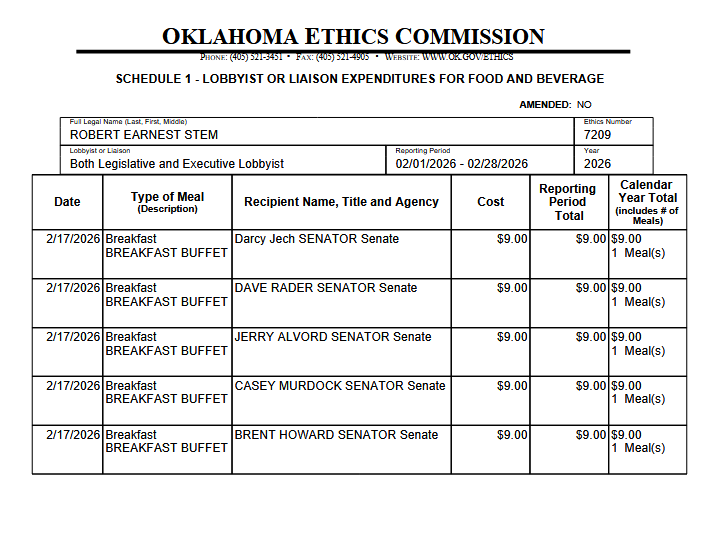
Which lobbyist happened to take key members of Senate Transportation and Judiciary Committee leadership to breakfast the day before the Petroleum Alliance article conveniently dropped?


Coincidence?
Maybe.
But the timing raises obvious questions.
According to the Ethics Commission expenditure reports, the total cost of that breakfast was $45.
Apparently in Oklahoma, $45 worth of breakfast is enough to stop citizen protective eminent domain reform bills from even getting a hearing.
Lobbyists don’t spend money on breakfast for the pancakes.
So maybe the real question isn’t why citizens are suddenly being called “terrorists.”
Maybe the real question is who benefits when these bills never receive a vote.
The answer isn’t hard to find.
Major state condemning agencies, like ODOT and OTA.
And if you want to understand the network of interests involved, the Oklahoma Ethics Commission’s Guardian Electronic Reporting System provides a useful window.
There you can see the current lobbying principals represented by Capitol Gains, LLC — the lobbying firm run by Mr. Stem.
The disclosures also show something else worth noting.
The filings show that the Associated Oklahoma General Contractors (AOGC) is registered to lobby agencies such as ODOT, the OTA, ODEQ, the Legislature, and the Governor’s office.
What the filings do not say is that AOGC is authorized to lobby on behalf of those agencies.
Yet that is exactly what appeared to happen during the March 3 press conference held at the ODOT building immediately following the OTA board meeting.
Which raises an important question about how state agencies and outside lobbyists are interacting in the first place.
Because if lobbyists are speaking for state agencies, the public deserves to know who authorized it.
Taken together—the Capitol breakfast with committee leadership, the sudden justification for halting eminent domain reform, and a press conference inside a state agency building labeling citizens “terrorists”—the sequence of events begins to look less like coincidence and more like a coordinated effort to shut down debate.
An interesting aside.
In 2019, Gov. Stitt issued Executive Order 2019-29 stating that it is “not a proper use of state funds for any state agency, board, or commission to expend taxpayers’ money on the hiring of outside lobbyists to lobby the State’s legislators on behalf of any state agency, board, or commission.”
Sounds good right?
But then Gov. Stitt gave the state agencies an out…… He went on to “prohibit all “state agencies,” …. from entering into an new or renewing any existing, contract or any other agreement with a Lobbyist for the purpose of Lobbying without first securing the express, written approval of the appropriate Cabinet Secretary.”
In other words, the practice wasn’t really prohibited—it just required permission.
So what was presented as a reform still allowed the same behavior to continue legally with a bureaucratic rubber stamp.
But I digress.
At the time, Mr. Stem publicly praised the order and offered his own thoughts on the proper role of lobbying in state government.
“I actually commend the governor for this action. Although it’s against my self-interest, I believe that his intentions are pure,” Stem said. “The best lobbyist for any agency is the director because, in all honesty, every agency should simply be providing information, not influencing policy.” - Bobby Stem, Lobbyist

In other words, according to Mr. Stem himself, agencies should be providing information — not influencing policy.
That standard seems especially relevant now.
To be clear, lobbyists are expected to advocate for the interests of their clients. If Mr. Stem’s principal is the Associated Oklahoma General Contractors (AOGC), it is entirely appropriate for him to defend the industry’s policy positions.
But the March 3 press conference raised a different question.
Was this a lobbyist advocating for his client, or a lobbyist appearing to speak on behalf of the very state agencies his client is registered to lobby?
The event was held inside the ODOT building immediately following the Oklahoma Turnpike Authority board meeting, and the remarks focused heavily on defending the agencies’ actions while attacking citizens opposing the project.
When a private lobbyist appears to deliver a policy defense from inside a state agency building immediately after that agency’s official meeting, it naturally raises questions about coordination and the proper use of government facilities.
Five Eminent Domain Reform Bills Cleared the Legislature’s Committees — Now Leadership Must Let Them Be Heard
Despite a directive from legislative leadership to stop hearing eminent domain reform bills, five major property-rights bills have successfully cleared every committee hurdle this session. Each bill addresses a different weakness in Oklahoma’s current eminent domain framework—burden of proof, the definition of public use, landowner rights, transparency in the turnpike process, and relief for families displaced by government takings. These bills now stand at the final gate: a floor hearing. If legislative leadership places them on the agenda, the full House and Senate will finally have the opportunity to debate and vote on reforms that thousands of Oklahoma landowners have been asking for.
📢 Ask Legislative Leadership to Place These Bills on the Floor Agenda
🏛️ OKLAHOMA HOUSE
📌 Contact:
House Floor Leader Josh West
📧 josh.west@okhouse.gov
📞 405-557-7415
🗣 Ask him to place on the House Floor Agenda:
HB 3453 (Reps. Staires/Wilk and Sen. Reinhardt)
Ensures the burden of proof always remains on the condemning authority and makes clear that a boilerplate Resolution of Necessity is not conclusive—while allowing attorney fee recovery for prevailing landowners so ordinary citizens can realistically challenge unlawful or unnecessary takings.
HB 3968 (Reps. Menz/K.West/Staires and Sen. Standridge)
Provides a clear statutory definition of “public use,” explicitly prohibiting takings for economic development and preventing local governments from expanding eminent domain powers without express legislative authorization. This bill restores constitutional guardrails and ensures condemnations occur only for truly public purposes.
🏛️ OKLAHOMA SENATE
📌 Contact:
Senate Floor Leader Julie Daniels
📧 julie.daniels@oksenate.gov
📞 405-521-5634
🗣 Ask her to place on the Senate Floor Agenda:
SB80 (Standridge/Bergstrom/Sacchieri) – OTA Accountability - SB 80 restores transparency and legislative oversight to the turnpike process. It requires explicit legislative authorization for new routes, mandates meaningful public notice and local public meetings, and ensures full disclosure of project maps, reports, and details to state and local leaders. The bill also strengthens public records accountability, prevents self-dealing by OTA officials, and includes a five-year sunset so new route authorizations expire if real design work does not begin.
One HUGE breakthrough for this bill came when the March 4th audit was released. We now have “official” leverage to get this bill heard. The Auditor wrote on page five of the report that “OTA management noted that they do not anticipate most of the remaining authorized projects every being built, and THEY WOULD LIKE TO UPDATE THE STATUTE TO REFLECT THIS.”
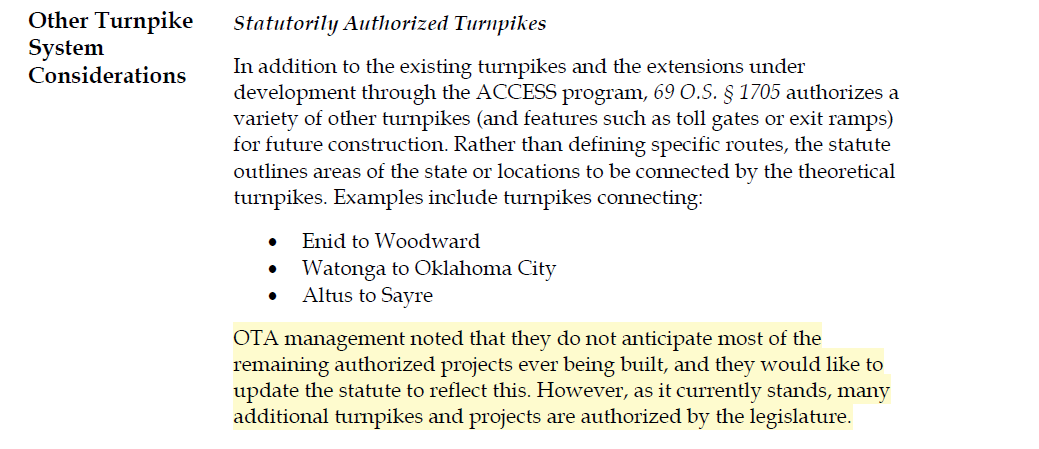
The Legislature asked for evidence.
The State Auditor just provided it.
So what are we waiting for?
Let’s do this.
At this point, the only thing standing between this bill and passage is the Legislature’s willingness to act.
SB2001 (Standridge and Rep. Blair) – Ad Valorem Tax Relief for Displaced Homeowners - SB 2001 as currently written, provides a three-year ad valorem (property) tax exemption for those property owners displaced specifically by the Oklahoma Turnpike Authority through the eminent domain process.
SB1945 (Standridge/Boren/Bullard and Rep. Menz) - Strengthens the Landowner’s Bill of Rights by requiring clear, plain-language notice at the earliest stage of condemnation, clarifying what constitutes a bona fide good-faith negotiation, and ensuring landowners understand their rights before property is taken. This improves transparency and fairness without impeding legitimate public projects.
These five bills simply ask government agencies to do something very basic: show their work.
Show that the land is truly needed.
Show that the project serves a real public use.
Show that landowners are treated fairly.
Show that the public can see how decisions are made.
If those things can be proven, these bills should not be controversial.
But if they can’t, then perhaps that explains why some lobbyists would rather call homeowners “terrorists” than allow these bills to reach the floor.
The Long-Awaited Investigative Audit is Released
On Wednesday, March 4th the Auditor and Inspector General, Cindy Byrd, released a 43 page report discussing findings of a limited-scope, 2-year long audit of the Oklahoma Turnpike Authority (OTA).

The scope was limited arbitrarily to the public-facing timeline of the ACCESS Oklahoma program (2022-2025), and detailed six specific topical areas deemed to be “assessed as higher risk or identified through preliminary procedures, discussion with the AG, and stakeholders’ concerns.”
Remember that the original call for the Audit came from the Attorney General’s (AG’s) office in March of 2023, but the Auditor was so busy with other audits, that her office did not start this until sometime in 2024.

I encourage you to read through the Audit and in the coming weeks I will give you an overview of what I thought about it.
But I will say this.
The headlines may say “no wrongdoing,” but the footnotes tell a very different story.
There was one location where the Auditor said the OTA was out of compliance with the Statute 708.2G.
So doesn’t “out of compliance with the law” mean they BROKE THE LAW?
Technically YES.
So why did the auditor include this headline in her audit?
“We did not find instances of egregious wrongdoing or significant statutory non-compliance.”
Hmmmm…
Then, there were two other areas where the auditor said the OTA could not DEMONSTRATE compliance. That means that the agency cannot prove the law was followed.
Then she went on to say that there was “potential” noncompliance with inter-agency contract laws because she could not independently verify whether services paid for were actually provided.
Well, then who will independently verify that? Isn’t that the point of an investigative audit?
It seems like the OTA was given a pass because they couldn’t provide the correct paperwork.
Regular citizens aren’t given that pass. Why was an “instrumentality” of the state with no debt ceiling and the state’s sovereign power of eminent domain given a pass?
Then there were several other findings (non-statutory violations), like conflicts-of-interest between the program manager and consultant roles, weak internal controls, poor invoice oversight, consultant cost escalation and surplus land sale transparency. These were framed as “governance risks, not violations.”
An agency that holds the power to issue billions in debt and take private land should be held to the highest standard of transparency and accountability — not the lowest.
For now, I’ll leave it there. But in the coming weeks we’ll take a closer look at what this audit actually says… and what it doesn’t.
I’m interested to hear your take on it.
Sometimes the biggest policy decisions in Oklahoma aren’t made on the House or Senate floor — they’re made over breakfast before the public even knows what’s on the menu.
Have a great Spring Break and don’t forget to contact your legislators!


